How to Clean Solar Panels (And When You Actually Need To)
How to Clean Solar Panels (And When You Actually Need To)
Most rooftop residential solar panels in the United States don't need to be cleaned. Rain handles roughly 95% of the work, and for the typical homeowner, paying $150–$400 for a professional cleaning service buys back a fraction of a percent in annual production.
There are real exceptions — and we'll name them precisely. But the honest version of this article is shorter than what you'll find on most installer blogs, which tend to recommend monthly cleanings that the data doesn't support.
TL;DR
Typical annual production loss from soiling is 1–5% in most U.S. climates. Rainy regions sit near the bottom of that range. Deserts and high-pollution areas sit near the top.
One annual cleaning improves output by roughly 0.4 percentage points in most residential settings — often less than the cost of the service.
Cleaning matters more for specific situations: drought regions, heavy pollen, ag/construction zones, bird-staining, ground-mounted systems, and after wildfires.
The real risk of cleaning isn't dirty panels — it's falling off your roof. Most homeowners should rinse from the ground or hire a pro.
What the Data Actually Says
The "you're losing 25% of your production to dirty panels!" claim that opens most cleaning-service articles isn't true for residential rooftop solar in the U.S.
NREL maintains a network of soiling stations across the country and publishes the actual numbers. Losses are quantified by insolation-weighted soiling ratio (IWSR); an IWSR of 0.95 indicates 5% annual energy loss to soiling. Across the U.S., NREL has estimated that annual PV soiling losses can range from zero to 7% — and the higher end is concentrated in specific arid, dusty, or industrial regions.
For most American homeowners, the realistic numbers look like this:
Environment | Typical annual soiling loss |
|---|---|
Rainy climates (PNW, Northeast, Southeast) | 1–2% |
Suburban, mixed climate | 2–4% |
Arid/desert (Southwest) | 4–7% |
Near major roads, high traffic | +1% on top of base |
Near agricultural operations | +1–2% on top of base |
And here's the part that almost no cleaning-service article mentions: An NREL model that uses a steady soiling increase found that, for a system that would build up soil that blocks 1.9% of sunlight over the course of a year, having one annual cleaning would maintain the loss around 1.5%, two cleanings per year could drop the average loss to 1.3%, and three cleanings per year would reduce that further to 1.2% average annual loss.
In plain English: one annual cleaning on a typical residential system buys back about 0.4 percentage points of production. On a 10 kW system producing 14,000 kWh per year at $0.16/kWh, that's roughly $9 per year. Three cleanings a year buys back maybe $16. Most professional cleanings cost $150–$400.
The math doesn't pencil for most homes. It does pencil for some.
When Cleaning Is Actually Worth It
Skip the rest of this article if you're in a normal suburban environment with regular rain. Pay attention if any of these apply to your situation:
Long rain-free stretches. If you live somewhere that goes 3+ months without meaningful rain — much of California, the Southwest, parts of Texas during summer — soiling builds up to the point where a cleaning before the next dry season ends genuinely pays back.
Heavy pollen seasons. Spring in much of the country leaves a yellow film that rain doesn't always rinse off cleanly. Note that the above algorithms do not adequately address the impacts of pollen and biosoiling — meaning the standard soiling models likely understate the impact during heavy pollen periods. A targeted post-pollen rinse helps.
Near agricultural operations. Dust kicked up from fields, plus drift from crop spraying, deposits a sticky residue that doesn't wash off the way urban dust does.
Active construction nearby. Construction dust is heavier and more abrasive than typical urban particulate. If a neighbor is mid-renovation or there's site work next door, a cleaning after the project wraps is reasonable.
Coastal salt spray. Within a few miles of the ocean, salt deposits accumulate and don't fully rinse with fresh water. A periodic rinse with deionized or soft water helps.
Bird droppings. This is the one exception where the "20% loss" stat has any basis. A single bird dropping covering a few cells can disable an entire string due to how panel circuitry works. Spot-cleaning bird strikes is worth doing promptly.
Wildfire smoke and ash. Ash is particularly bad — it's fine, sticky, and chemically reactive. Post-wildfire cleaning is one of the few situations where output gains are dramatic and immediate.
Ground-mounted systems at low tilt. Steeper tilt angles let rain self-clean panels effectively. Below about 10 degrees of tilt, water pools and dirt stays. Most rooftop systems are above that threshold; ground-mounts often aren't.
How to Clean Panels Safely (If You Have To)
If one of the above applies, here's the actual method.
When to clean. Early morning or late evening, never midday. Hot panels can crack from cold water (thermal shock), and you don't want to be standing on a hot roof in direct sun anyway.
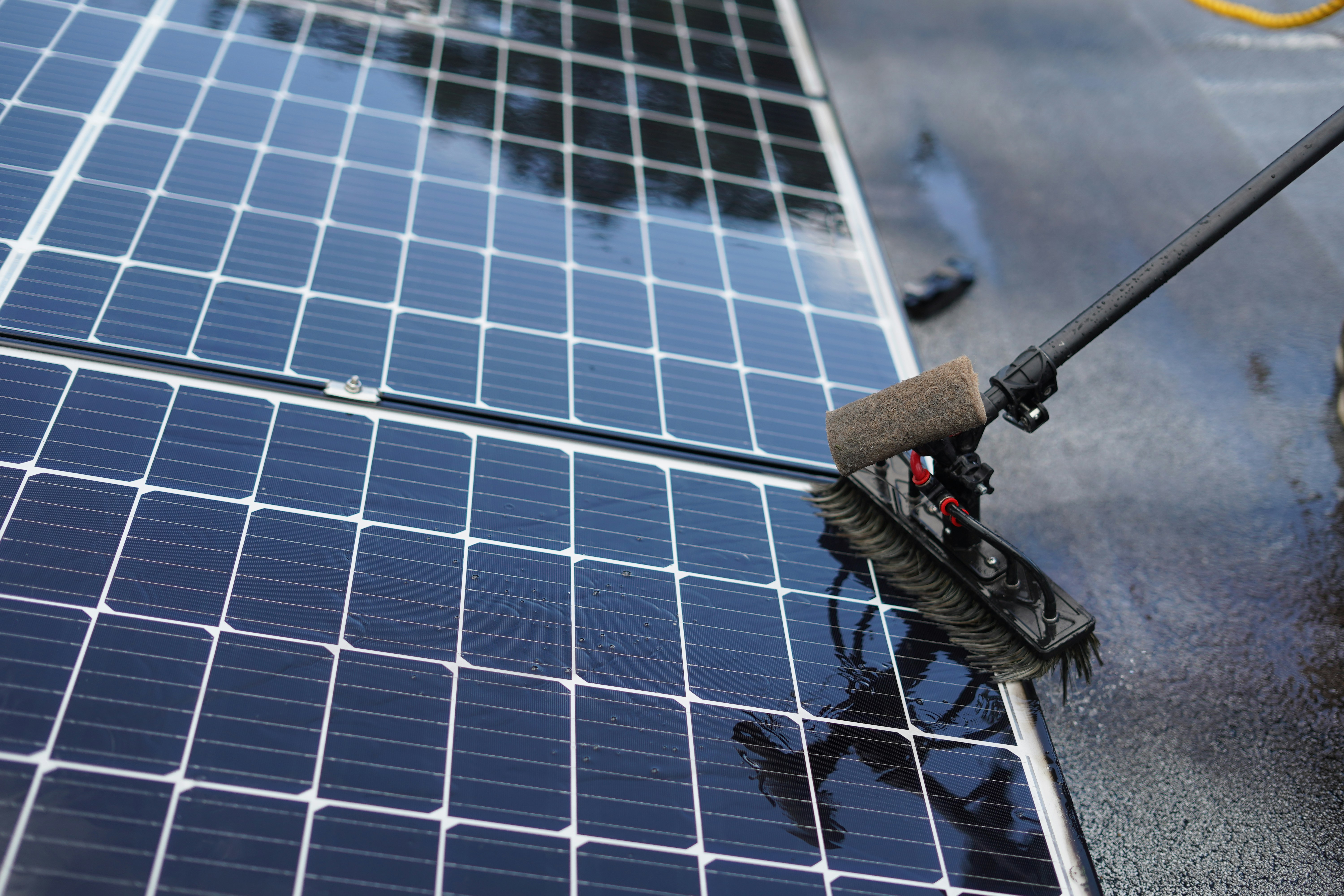
What to use. Plain water, applied gently. A garden hose with normal pressure handles 80% of soiling situations. For stubborn deposits, add a soft brush or microfiber on an extension pole. In hard-water regions, use deionized or distilled water for the final rinse — hard water leaves mineral deposits that worsen soiling over time.
What to skip. No pressure washers — they can force water past panel seals and almost universally void manufacturer warranties. No abrasive scrubbers, no metal tools, no harsh detergents. The "vinegar and dish soap" advice that circulates on home-improvement sites isn't supported by manufacturer guidance and risks leaving residue that attracts dirt.
How to handle the roof. This is the part most articles skip. Residential roof falls send tens of thousands of Americans to emergency rooms each year. If you're not already comfortable working on your roof — with appropriate fall protection — clean from the ground using a pole-mounted brush, or hire a professional. The 0.4% production gain is not worth a hospital visit.
A note on warranties: most panel manufacturers explicitly require gentle, water-based cleaning and prohibit pressure washing or abrasive cleaning.
What About Robots and Self-Cleaning Coatings?
Cleaning robots and hydrophobic coatings exist for residential systems, but the math is even worse than for professional cleanings. Robots run $1,000+ for systems whose annual soiling losses might be worth $20–$40 in recovered production. Self-cleaning coatings degrade over time and can interfere with panel warranties.
For commercial and utility-scale solar in dusty climates, these technologies make sense. For your roof, they almost never do.
What a PPA Actually Covers (and What It Doesn't)
If you're shopping solar under a Power Purchase Agreement (PPA) — where the provider owns the equipment and you pay per kWh produced — the responsibility split is worth understanding before you sign.
Under PowerGuard's PPA, equipment maintenance, monitoring, performance guarantees, and any parts/labor for the system itself are PowerGuard's responsibility for the full 25-year term. If a panel fails, an inverter dies, or the system underproduces against its annual estimate, that's on us to fix or true up.
Physical cleaning of the panels, however, remains the homeowner's responsibility — including engaging a contractor for periodic cleaning if your environment calls for it. The contract also requires homeowners to maintain shading conditions (i.e., trim trees that grow into the panels' line of sight over time).
For most homeowners in most U.S. environments, this distinction doesn't translate to much real work, because — as the rest of this article covers — rain handles 95% of the cleaning anyway. But if you're in one of the environments named earlier where periodic cleaning genuinely matters, you should plan on it being your responsibility under a PPA, not the provider's.
The trade-off is straightforward: you're not on the hook for the system's mechanical reliability, but you are on the hook for keeping the panels physically accessible to sunlight.
FAQ
How often should I clean my solar panels? For most U.S. homes, never to once per year. If you're in a drought, dust, pollen, ag, or coastal environment, once or twice per year. After wildfire smoke or heavy bird activity, address promptly.
Can I clean solar panels with vinegar? Manufacturer guidance generally doesn't endorse vinegar or dish soap. Plain water — ideally soft or deionized — is the safest choice. Vinegar can leave residue that attracts more dirt over time and may affect anti-reflective coatings on some panels.
Will dirty solar panels void my warranty? No, but improper cleaning can. Pressure washing, abrasive tools, and harsh chemicals are the most common warranty-voiders. Routine soiling does not affect warranty coverage.
Should I hire a professional to clean my panels? For most homes, no — the cost typically exceeds the recovered production value. For homes in drought regions, near agriculture, or with hard-to-reach roofs, yes — both for the production gain and for safety reasons.
Does rain really clean solar panels? Mostly, yes. Rain handles general dust and particulate effectively, especially on roof-mounted panels with reasonable tilt angles. It does not handle bird droppings, sticky pollen, ash, or hard mineral deposits — those require manual attention.
The Bottom Line
If you've been told you need to clean your solar panels regularly, you've probably been talking to someone who sells cleaning services. The data is clear: for most American homes, rain handles it. The exceptions are real and worth paying attention to — but they're exceptions, not the rule.
If you're considering solar and want to understand exactly what's covered under a PPA — and what isn't — a 20-minute consultation can walk through both the maintenance scope and your specific production estimate. See if a PPA fits your home
Insights & Updates
Explore articles, resources, and ideas where we share updates about the product, thoughts on technology, and lessons learned while building along the way.
Insights & Updates
Explore articles, resources, and ideas where we share updates about the product.