How Does Solar Power Work for Your Home?
How Does Solar Power Work for Your Home?
Roughly 7% of American homes have rooftop solar today, and SEIA projects that figure will more than double by 2030. More than 5 million solar installations are now operating across the country. [Source: SEIA]
What none of that scale tells you is the part most homeowners actually want to know: how does the thing on the roof end up powering the toaster in the kitchen?
TL;DR
Solar panels turn sunlight into DC electricity. An inverter converts that DC into AC, which is what your home runs on.
Solar power feeds into the same circuits as utility power. Your appliances don't know or care where the electrons came from.
Extra power either flows to the grid or charges a battery. What happens depends on your utility and whether you have storage.
You barely have to do anything. Most homeowners interact with solar through a phone app once a month, if that.
The 30-Second Version
Sunlight hits panels on your roof. The panels generate electricity in a form your house can't use directly. An inverter — usually mounted on your garage wall or in a utility area — converts that electricity into the form your house can use, and feeds it into your electrical panel like any other power source. From there, it flows to your outlets, your AC, your fridge, exactly the same way utility power does.
If your panels make more electricity than you're using at any given moment, that extra power either flows back to the utility grid (you get credit for it) or charges a home battery (you store it for later). When the sun isn't shining, you pull from the grid or your battery — same as any other home.
That's the whole system. Everything below is detail on how each piece actually works.
Step 1: The Panels (Where Electricity Gets Made)
A solar panel is a sheet of silicon cells under tempered glass. When light hits silicon, it knocks electrons loose. When electrons move in a controlled direction, you have electricity. That's the photovoltaic effect, and it's the entire trick.
A few things worth knowing as a homeowner:
The panels work in any daylight, not just full sun. They produce less power on cloudy days, but they don't shut off — they still capture diffuse sunlight that scatters through clouds. (For specifics, see Do Solar Panels Still Work on Cloudy Days?.)
Panels produce direct current (DC). This matters because your home runs on alternating current (AC). The panels can't talk directly to your outlets. Something has to translate between them.
Modern panels typically last 25–30 years and degrade slowly — about 0.5% per year — meaning a panel installed today will still produce around 87–90% of its rated output 25 years from now. That long, slow decline is why solar is treated as a long-term investment rather than a gadget.
Step 2: The Inverter (The Brain of the System)
The inverter is the most under-explained part of residential solar. It's also the component most homeowners never see in marketing materials, and the one most likely to fail first.
Its job is simple: convert DC from the panels into AC for your home. But it does several other things too — monitors system performance, communicates with the grid, ensures safety during outages, and feeds your monitoring app the data you'll occasionally check.
There are two common configurations:
String inverter: A single inverter, usually mounted on the garage wall, that handles the whole array. Cheaper, simpler, but if one panel is shaded or underperforming, the whole string suffers.
Micro-inverters: A small inverter on the back of each individual panel. More expensive, but each panel operates independently — shade or debris on one panel doesn't drag down the rest. Most modern residential installations use micro-inverters or a hybrid configuration with power optimizers.
Inverters typically have warranties of 10–25 years depending on type. They're the most likely component in a solar system to need replacement during the panels' lifetime — worth knowing when you're evaluating warranty terms.
Step 3: Your Home Electrical Panel (Where It Actually Gets Used)
Once the inverter has converted DC to AC, the electricity feeds into your home's main electrical panel — the same gray box in your basement, garage, or utility closet that handles power from the utility.
This is the part most homeowners find anticlimactic. Solar power and utility power flow into the same panel and out through the same circuits. Your fridge doesn't know which power source it's drawing from at any given moment. Your AC doesn't care. The panel just sees electricity and routes it where it's needed.
This is what installers mean when they say solar is "behind the meter." Power produced by your panels is consumed by your home before it ever reaches the utility's metering point. You only interact with the utility when your home is using more than the panels are producing — or producing more than the home is using.
Step 4: The Grid (or the Battery)
Here's where it gets interesting, and where competitor articles usually wave their hands.
Solar production doesn't match home usage. Panels produce most of their power between roughly 9 AM and 4 PM, peaking around midday. But most home electricity use happens early morning and evening — when people are home, cooking, running laundry, watching TV. So during the middle of a sunny day, your panels are typically producing more than your home is consuming.
That extra power has to go somewhere. It has two possible destinations:
The grid. With grid-tied solar (the most common setup), excess power flows back through your meter and out to the utility. Most utilities credit you for that exported power on your bill. The mechanism is called net metering or, in some states, net billing.
A battery. With solar + storage, excess power charges a home battery instead of flowing to the grid. You then use that stored power in the evening, after sunset, or during outages.
The economics of which path makes more sense have shifted considerably in recent years. In states where utilities pay full retail rate for exported power, grid-tied solar without storage works fine. In states where exported power is credited at a fraction of retail (this is increasingly common — California's NEM 3.0 / Net Billing Tariff is the most prominent example), batteries make a much bigger financial difference because they let you use your own solar power instead of "selling" it back at a discount.
What the Meter Actually Does
A quick note on something that confuses a lot of new solar owners: your utility meter changes shape, not just direction.
A traditional utility meter measures power flowing into your home. A net meter (or bidirectional meter) measures power flowing in and out separately. You'll see two numbers on your bill — kWh imported from the grid (you pay for these) and kWh exported to the grid (you get credited for these, often at a different rate). Your bill becomes the math of import minus export, plus any fixed connection charges.
This is also why "my power bill went to zero" claims are usually misleading. Most utilities still charge a fixed monthly connection fee even if your solar covers all your kWh usage. The meaningful number is the kWh charge, which can shrink dramatically.
How Homeowners Actually Get Solar
A quick aside, because it usually comes up at this point:
There are three common ways homeowners get solar: paying cash, financing with a solar loan, or signing a Power Purchase Agreement (PPA) where the solar company owns the equipment and you pay per kWh of solar power produced. Each has trade-offs around upfront cost, ownership, maintenance, tax treatment, and home-sale implications.
PowerGuard offers $0-down PPAs and is available in a growing number of states. We're not going to get into the comparison here — that's its own piece. Worth flagging only because it's relevant context for how the rest of this article applies to you.
Step 5: What Happens During an Outage
This is the part most homeowners get wrong.
Standard grid-tied solar systems shut off when the grid goes down. This is required by federal safety standards (it's called anti-islanding) — it prevents your system from sending power into a grid that utility workers are repairing, which could electrocute them. But it also means that without storage, your solar panels are useless during the exact moments you might want them most.
Solar paired with a home battery works differently. The battery, combined with a transfer switch, can isolate your home from the grid during an outage and run on stored solar power. The system keeps your panels producing through the day, recharging the battery, and you ride out the outage on solar.
The portable "solar generator" units sold at Costco and Home Depot are a different category entirely — they're not connected to your roof and operate independently. They have their own use cases, and we cover the full comparison in Solar Generator vs. Battery Backup.
What the Homeowner Actually Does
Almost nothing.
Once your system is installed and commissioned, your day-to-day involvement is:
Check the monitoring app occasionally. Most modern systems include a phone app that shows real-time and historical production. Most homeowners check it weekly for the first month and monthly thereafter.
Watch your utility bill. This is the actual signal that your system is working. Production drops in winter and rises in summer, but the annual pattern should match what you were quoted.
Address the rare problem. Inverters fail. Squirrels chew wires. New tree growth eventually shades a panel that wasn't shaded at install. These things happen — rarely — and your installer or PPA provider handles them.
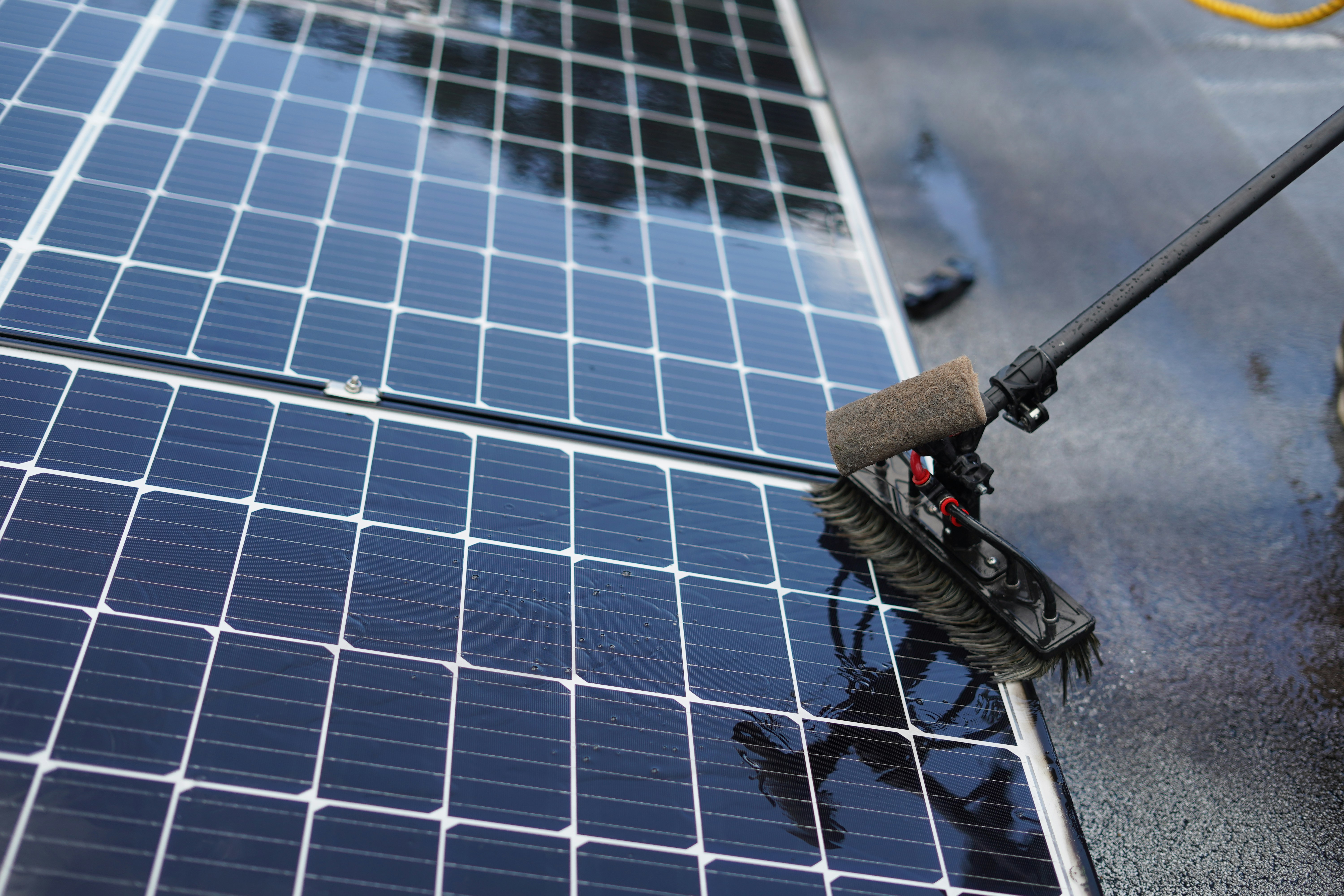
Cleaning, in most cases, is unnecessary. Rain handles 95% of it. The exceptions (drought regions, near agriculture, post-wildfire) are covered in How to Clean Solar Panels.
That's it. There's no fuel to buy, no monthly maintenance task, no ritual. The system runs in the background.
What Can Go Wrong
A short, honest section because credibility matters and the brochure-y articles skip this.
Panel degradation. Real but slow. Roughly 0.5% per year. By year 25, your panels produce 87–90% of what they did at install.
Inverter failure. The single most common failure point. Most inverters last 10–15 years; the panels outlive them. Plan for at least one replacement during the system's life if you own it outright. Under a PPA, this is typically the provider's responsibility.
Shading from new tree growth. A roof that was unshaded at install can become partially shaded years later. Micro-inverters mitigate the impact; tree trimming addresses it.
Storm damage. Rare but not zero. Hail-rated panels handle most weather; insurance usually covers the rest.
System monitoring lapses. If the monitoring app stops reporting data, the system might be down without you knowing. Worth checking the app every few weeks.
The Real Reason Any of This Matters
The mechanics aren't just trivia. They determine your savings.
How much your panels produce, what your utility pays you for exports, how much you store in a battery vs. send to the grid, when you use power vs. when you produce it — these are the variables that turn into a real number on your bill. Two homes with identical panels can have wildly different solar economics depending on utility rates, time-of-use schedules, household usage patterns, and whether they have storage.
That's why "how much will I save with solar" is impossible to answer in a blog post. The honest version of that conversation requires looking at your specific roof, your specific utility, and your specific usage. A 20-minute consultation with PowerGuard will give you that number — actual production estimates and an actual monthly cost under a $0-down PPA. Get your custom estimate.
FAQ
Do solar panels work at night? No — panels need photons (sunlight) to generate electricity. At night, your home pulls from the grid, from a battery if you have one, or both.
How long do solar panels last? Most modern panels are warrantied for 25–30 years and continue producing well past that. Production declines roughly 0.5% per year, so a 25-year-old panel still produces about 87–90% of its original output.
What happens if I produce more power than I use? Excess power flows to the grid (and you get credited, at a rate that depends on your utility) or charges a home battery if you have one. Some combination of both is increasingly common.
Do solar panels work in winter? Yes — sometimes better than expected, because panels are more efficient in cold weather. The trade-off is shorter days and lower sun angles, so winter production is lower than summer overall. Snow on panels temporarily zeroes out production until it slides off.
Can solar power my whole house? A properly sized solar system can cover 100% of your annual electricity usage. Whether it powers your house at any given moment depends on time of day and weather. Solar + battery storage gets you closest to true energy independence.
Insights & Updates
Explore articles, resources, and ideas where we share updates about the product, thoughts on technology, and lessons learned while building along the way.
Insights & Updates
Explore articles, resources, and ideas where we share updates about the product.